
Table of Contents
Wormholes Travel: 5 Mind-Blowing Realities About Cosmic Shortcuts
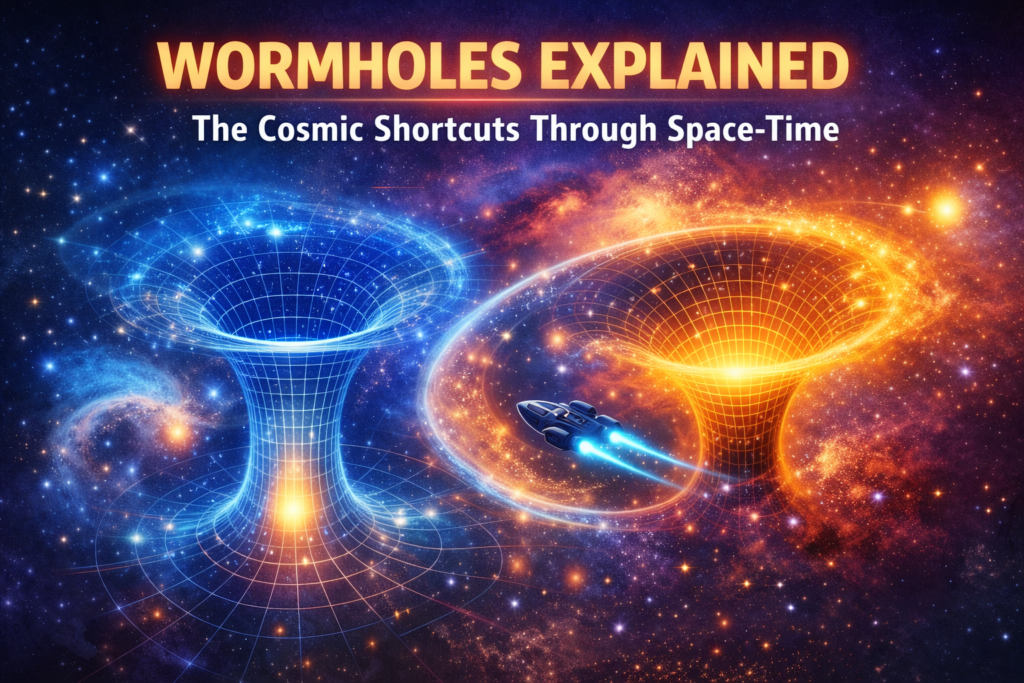
Wormholes travel represents one of the most tantalizing possibilities in theoretical physics—a potential solution to the vast distances separating us from the stars. Imagine journeying across millions of light-years in what feels like moments, stepping through a celestial portal that defies conventional space-time limitations. This revolutionary concept of wormhole travel isn’t merely science fiction; it’s grounded in serious scientific frameworks that suggest shortcuts through the universe’s fabric might mathematically exist, potentially overcoming the greatest challenge of interstellar exploration.
The immense scale of our universe presents a formidable barrier to human exploration. Consider that our nearest galactic neighbor, Andromeda, lies approximately 2.5 million light-years away. With our current propulsion technology, reaching it would require roughly 94.5 billion years—far exceeding the universe’s current age of about 13.8 billion years. Even traveling at light speed—physically impossible for matter with mass according to Einstein’s relativity—would still demand 2.5 million years. Wormhole travel theoretically bypasses these limitations by warping space-time itself, offering potential shortcuts that could connect distant cosmic locations through tunnel-like passages.
The Science of Wormholes: Theoretical Foundations
The concept of wormhole travel originates from Einstein’s theory of general relativity. In 1935, Albert Einstein and Nathan Rosen first mathematically described these structures as “Einstein-Rosen bridges”—solutions to Einstein’s field equations that connect two separate points in space-time (Einstein & Rosen, 1935). These theoretical constructs suggest that space-time can be folded, allowing for shortcuts between distant regions.
Physicist John Wheeler later coined the term “wormhole” in 1957, drawing analogy to how a worm might travel through an apple rather than around its surface. While often dramatized in science fiction, the mathematical foundation for wormhole travel remains an active area of theoretical physics research, with scientists like Kip Thorne further developing concepts of traversable wormholes (Thorne, 1994).
Types of Wormholes: From Microscopic to Traversable
Theoretical physics suggests several potential wormhole varieties that could enable wormhole travel:
- Einstein-Rosen Bridges: The original mathematical solutions describing connections between black holes and white holes
- Morris-Thorne Traversable Wormholes: Hypothetical wormholes that could remain stable enough for travel using exotic matter with negative energy density (Morris & Thorne, 1988)
- Quantum Wormholes: Microscopic wormholes potentially existing at quantum scales, as suggested by some interpretations of quantum gravity
- Lorentzian Wormholes: Solutions to Einstein’s equations that potentially allow for two-way travel without violating causality
Each type presents different possibilities and challenges for practical wormhole travel, with traversable wormholes being the most relevant for human exploration.
Challenges and Limitations of Wormhole Travel
Despite intriguing theoretical foundations, wormhole travel faces significant scientific obstacles:
Exotic Matter Requirements: Traversable wormholes would likely require “exotic matter” with negative energy density to remain stable against gravitational collapse. While quantum phenomena like the Casimir effect demonstrate negative energy in controlled settings, we lack evidence of naturally occurring exotic matter in sufficient quantities (Visser, 1995).
Navigation and Control: Creating and controlling wormhole endpoints presents extraordinary challenges. The energy requirements alone might exceed what entire civilizations could generate. According to theoretical calculations, stabilizing a wormhole just one meter in diameter might require energy equivalent to the mass of Jupiter (Hochberg & Visser, 1998).
Temporal and Causality Concerns: Certain wormhole configurations could theoretically allow time travel, potentially creating paradoxes like the famous “grandfather paradox.” This has led some physicists to propose chronology protection conjectures that might prevent such violations of causality (Hawking, 1992).
Current Research and Scientific Investigations
Contemporary research into wormhole travel spans multiple scientific disciplines:
Quantum Gravity Studies: Researchers are exploring potential connections between wormholes and quantum entanglement through concepts like the ER=EPR conjecture (Maldacena & Susskind, 2013). This suggests fundamental links between space-time geometry and quantum information theory that might eventually inform practical approaches to manipulating space-time.
Laboratory Analogues: In 2015, researchers at the Autonomous University of Barcelona created a “magnetic wormhole” that transmitted magnetic fields through an invisible tunnel (Navau et al., 2015). While not enabling matter transmission, this experiment demonstrated that wormhole-like connections can exist for specific fields, validating some theoretical principles in controlled environments.
Numerical Simulations: Advanced supercomputers now simulate extreme space-time geometries, allowing researchers to model wormhole dynamics under various conditions. These simulations help identify potentially stable configurations and understand the behavior of matter and energy in such extreme environments (Lobo & Oliveira, 2009).
Wormhole Travel in Popular Culture and Public Imagination
Wormhole travel has captured public imagination through various media, most notably in Christopher Nolan’s film Interstellar, which consulted physicist Kip Thorne for scientific accuracy. While artistic liberties were taken, the film’s depiction of gravitational time dilation near massive objects and the visualization of traversable wormholes introduced millions to these complex concepts (Thorne, 2014).
Other notable appearances include:
- The television series Star Trek, featuring the Bajoran wormhole
- The film Contact, based on Carl Sagan’s novel
- Numerous video games and literary works exploring interstellar travel via wormholes
These representations, while often exaggerated, have stimulated public interest in theoretical physics and inspired new generations of scientists.
Ethical Considerations and Future Implications
If wormhole travel ever becomes possible, it would raise profound ethical questions:
Planetary Protection Protocols: How would we prevent biological contamination between different planetary systems? NASA’s Office of Planetary Protection currently establishes guidelines for robotic missions, but human wormhole travel would require far more stringent measures.
First Contact Scenarios: If wormholes exist naturally or become widespread, humanity might encounter extraterrestrial civilizations. Establishing protocols for peaceful interaction and mutual understanding would become paramount.
Resource Allocation and Access: The potentially enormous energy requirements for creating or stabilizing wormholes raise questions about equitable access and responsible use of cosmic-scale resources.
Temporal Responsibility: If time travel becomes possible through certain wormhole configurations, what ethical frameworks would govern historical observation or potential intervention?
Practical Steps Toward Understanding Wormhole Physics
While practical wormhole travel remains distant, several research directions show promise:
- Dark Energy Research: Studying the accelerating expansion of the universe might reveal insights into exotic forms of energy that could inform wormhole stabilization techniques (Riess et al., 1998).
- Quantum Information Advances: Progress in quantum computing and information theory might illuminate connections between quantum entanglement and space-time geometry, potentially revealing new approaches to manipulating space-time.
- Gravitational Wave Astronomy: Observations from facilities like LIGO and Virgo provide unprecedented data about extreme gravitational environments, including insights relevant to wormhole physics (Abbott et al., 2016).
- International Collaboration: Large-scale projects like the Event Horizon Telescope, which captured the first image of a black hole in 2019, demonstrate how global scientific cooperation can tackle fundamental questions about space-time and gravity.
The Future of Interstellar Travel: Wormholes and Beyond
Wormhole travel represents just one potential approach to interstellar exploration. Other theoretical concepts include:
Alcubierre Warp Drive: Proposed by physicist Miguel Alcubierre in 1994, this concept involves contracting space in front of a spacecraft and expanding it behind, potentially allowing faster-than-light travel without locally exceeding light speed (Alcubierre, 1994).
Generation Ships: The most plausible near-future approach involves self-sustaining spacecraft carrying multiple human generations during centuries-long journeys to nearby stars.
Laser-Pushed Lightsails: Concepts like Breakthrough Starshot propose using ground-based lasers to accelerate tiny spacecraft to significant fractions of light speed for interstellar reconnaissance missions.
Each approach presents different challenges, timelines, and implications for humanity’s future in space.
Conclusion: Bridging Imagination and Reality
Wormhole travel remains firmly in theoretical physics’ domain rather than practical engineering, likely separated from realization by fundamental physical barriers and technological limitations. Yet its continued study pushes multiple scientific frontiers, driving progress in quantum gravity, cosmology, and fundamental physics.
The enduring fascination with wormhole travel reflects humanity’s deepest aspirations: to explore, connect, understand, and transcend our limitations. Whether wormholes eventually become practical transit routes or remain mathematical possibilities that shape our understanding of space-time’s nature, their investigation enriches our comprehension of the universe’s deepest mysteries.
As astrophysicist Carl Sagan observed in his book Contact, “The universe is a pretty big place. If it’s just us, seems like an awful waste of space.” The pursuit of concepts like wormhole travel, while speculative, represents humanity’s refusal to accept cosmic isolation—a testament to our species’ relentless curiosity and boundless imagination when confronting the vast cosmic ocean surrounding our pale blue dot.
References & Further Reading:
- Einstein, A., & Rosen, N. (1935). The Particle Problem in the General Theory of Relativity. Physical Review, 48(1), 73-77.
- Thorne, K. S. (1994). Black Holes and Time Warps: Einstein’s Outrageous Legacy. W. W. Norton & Company.
- Morris, M. S., & Thorne, K. S. (1988). Wormholes in spacetime and their use for interstellar travel: A tool for teaching general relativity. American Journal of Physics, 56(5), 395-412.
- Visser, M. (1995). Lorentzian Wormholes: From Einstein to Hawking. American Institute of Physics.
- Hochberg, D., & Visser, M. (1998). Geometric structure of the generic static traversable wormhole throat. Physical Review D, 58(4), 044021.
- Hawking, S. W. (1992). Chronology protection conjecture. Physical Review D, 46(2), 603-611.
- Maldacena, J., & Susskind, L. (2013). Cool horizons for entangled black holes. Fortschritte der Physik, 61(9), 781-811.
- Navau, C., et al. (2015). Magnetic Wormhole. Scientific Reports, 5, 12488.
- Lobo, F. S. N., & Oliveira, M. A. (2009). Wormhole geometries in f(R) modified theories of gravity. Physical Review D, 80(10), 104012.
- Thorne, K. S. (2014). The Science of Interstellar. W. W. Norton & Company.
- Riess, A. G., et al. (1998). Observational evidence from supernovae for an accelerating universe and a cosmological constant. The Astronomical Journal, 116(3), 1009-1038.
- Abbott, B. P., et al. (2016). Observation of gravitational waves from a binary black hole merger. Physical Review Letters, 116(6), 061102.
- Alcubierre, M. (1994). The warp drive: hyper-fast travel within general relativity. Classical and Quantum Gravity, 11(5), L73-L77.
- Sagan, C. (1985). Contact. Simon & Schuster.
External Resources & Further Exploration:
- NASA’s Official Website on Gravity and Space-Time – Authoritative information on gravitational physics and space-time concepts from NASA’s Astrophysics division.
- Einstein Online: Wormholes – Educational resource from the Max Planck Institute explaining wormholes in accessible language with scientific accuracy.
- Stanford Encyclopedia of Philosophy: Time Travel – Philosophical examination of time travel concepts and paradoxes, relevant to wormhole discussions.
- arXiv.org Physics Section – Open-access repository of scientific papers including the latest research on wormholes, black holes, and related physics.
- The Planetary Society: Interstellar Travel – Nonprofit organization’s resources on practical and theoretical approaches to interstellar exploration.
- LIGO Scientific Collaboration – Information about gravitational wave detection and its implications for understanding extreme space-time events.
Also Visit Other Section of the Website: Click Here